Showing posts with label Forgs. Show all posts

Thursday, May 26, 2011

Mantella Baroni and Baron's Mantella Madagascar Species

Mantella baroni is a species of frog in the Mantellidae family. It is endemic to Madagascar. Its natural habitats are subtropical or tropical moist lowland forests, subtropical or tropical moist montanes, rivers, and heavily degraded former forest. Mantella baroni and Mantella madagascariensis for more information. A large and slender mantella, adult frogs can grow to 30 mm (1.2 inches). Females are generally bigger than males and more robust in appearance. Females also lack the ability to call. Frogs from populations in the southern most part of M. baroni’s distribution (in forest on the eastern side of the Andringtra Mountains) have variable amounts of green or yellow on the dorsum.


Habitat: forests of east-central Madagascar
Mantella Baroni

Because of their wide distribution, frogs from different populations may experience different temperatures. This makes it difficult to determine an ideal temperature range to keep captive frogs within when it’s not known where they were collected. Housing does not need to be complex, but it might be worth the effort to create an area of moving water within the terrarium because of their association with moving water in the wild.

Mantella Baroni - Baron's Mantella

Tomato Frog Exotic Pets and are Often ILLegally Collected

The tomato frog lives only in the exporting country and is often found in towns. Like other species with poisonous defenses, the palm-sized tomato frog boasts bright warning colors ranging from dark pink to fire-engine red. Tomato frogs are very popular as exotic pets and are often illegally collected. One pet shop owner in Osaka was caught selling 25 tomato frogs for $90 each. The frogs had been illegally imported through Switzerland.

Tomato Frog

Tomato Frog is any one of the three species of genus Dyscophus, also commonly known as Crapaud Rouge De Madagascar, is endemic to Madagascar. It is one of the most brightly colored frogs in the world. Its natural habitats are subtropical or tropical moist lowland forests. It can also be found living on rivers, swamps, freshwater marshes, intermittent freshwater marches, arable lands, plantations, rural gardens, urban areas, heavily degraded former forest, ponds, and canals and ditches. It is threatened by habitat loss.

Tomato Frogs will reach sexual maturity in 9 - 14 months. Females are larger than males and can reach 4 inches in length. Males can reach 2 to 3 inches in length. Most females range from reddish-orange bright dark red. The bellies are usually more yellowish, and sometimes there are black spots on the throat. But males are not as brightly colored but more of a duller orange or brownish-orange. Juveniles are also dull in color and develop brighter coloration as they mature.

Tomato Frog


EXPORTING COUNTRY CLUE:
The capital of this island country, located in the Indian Ocean, is Antananarivo.
 
IMPORTING COUNTRY CLUE:
The Sea of Japan is surrounded by the Russian Federation, North Korea, South Korea, and this country.

Amazon Milk Frog Habitat and Distribution

Amazon milk frog Baumhöhlen-Krötenlaubfrosch / Amazon Golden-eyed Tree Frog / Amazon Milk Frog (Trachycephalus resinifictrix )

The Amazon milk frog occurs in Bolivia, Brazil, Colombia, Ecuador, French Guiana, Peru, Suriname, Venezuela and possibly Guyana. This frog inhabits the canopy of tropical rainforests at elevations from sea level to about 1500 feet (450 m). It spends its entire life in the vegetation and seldom, if ever, descends to the ground.

The adult Amazon milk frog is either dark brown with light grey or white banding, or light grey with dark brown banding. Its skin has a very granular or bumpy texture. The legs, arms and digits have darker brown bars with cream borders. There is a large green triangle between the eyes. Its eye is golden in color with a black Maltese cross centered on the pupil. A juvenile Amazon milk frog is banded in black and white, but as it matures its contrasting colors change to that of the adult. It has a vocal sac located on each side of the head. This species is rather large for a tree frog and adults usually range in size from 2.5 to 4 inches
(6.3 -10 cm). Males are smaller than females.


Amazon milk frog


Diet/Feeding
Adults will consume almost any type of small arthropod (crickets, worms, caterpillars, flies and
locusts) that they can overpower and swallow.

Conservation Status
The Amazon milk frog is classified as “least concern” on the IUCN Red List. Additional Information. The common name “milk frog” refers to the poisonous, white, milky secretion that this frog may secrete through its skin when threatened. This species is nocturnal and is noted for its loud vocalizations. Males call only from water-filled tree cavities at heights between about 6 and 100 feet (2 - 32 m) above the ground. It calls to attract a female.

Amazon milk frog Baumhöhlen-Krötenlaubfrosch / Amazon Golden-eyed Tree Frog / Amazon Milk Frog (Trachycephalus resinifictrix )
Breeding occurs mainly during the rainy season, November to May. The female lays about 2,500 eggs in the water in the tree hole. The tadpoles hatch after one day. After three more weeks they metamorphose into tiny frogs.

Waxy Monkey Tree Frog Phyllomedusa Sauvagei Care Guide

Warziger Makifrosch / Waxy Monkey Tree Frog / Waxy Monkey Leaf Frog (Phyllomedusa sauvagei / sauvagii )

Waxy Monkey Tree Frogs-Phyllomedusa sauvagei are represented by two groups of frogs.  One group is wild caught and another is captive bred and born.  We feel this is a frog species that will undoubtedly become one of the most widely kept species simply based on ease of husbandry. The defensive skin secretions of many amphibians contain a wide spectrum of biologically active compounds, particularly antimicrobial peptides that act as a first line of defence against bacterial infection. Here we describe for the first time the identification of three novel dermaseptin-related peptides (dermaseptins sVI–sVIII) whose primary structures were deduced from cDNAs cloned from a library constructed from lyophilised skin secretion of the South American hylid frog, Phyllomedusa sauvagei. The molecular masses of each were subsequently confirmed by interrogation of archived LC/MS files of fractionated skin secretion followed by automated Edman degradation sequencing. The heterogeneity of primary structures encountered in amphibian skin antimicrobial peptides may inpart be explained by individual variation a factor essential for selective functional molecular evolution and perhaps, ultimately in speciation.


Waxy Monkey Tree Frog


Life span: About 10 years
General appearance: Green with shinny wax like skin.
Housing requirements:
Enclosure: Aquarium of 20 gallons or larger or similar enclosure. Enclosure top should be screen to allow for plenty of ventilation. A small water bowl and some branches to climb on are about all that is needed.

Temperature: The waxy monkey frog requires high temperatures. Temperature for these frogs should be in the mid 90º range during the day and mid 80º range at night. .
Heat/Light: A basking area with a temp of 95º F or higher is required and using a full spectrum UVB bulb is recommended by some.
Substrate: News paper or paper towels works best for this species. Potting soil, peat moss can be used but care must be taken to avoid damp conditions. Avoid using small bark and gravel due to danger of ingestion.

Waxy Monkey Tree Frog

Environment: The waxy monkey frog is a low humidity high temperature frog found in almost dessert conditions for much of the year.
Diet: Insectivores - crickets, cockroaches, locusts, moths and beetles are all eaten. Dust crickets with calcium and vitamins three times a week.
Maintenance: Clean the enclosure weekly. Remove dead insects and clean water bowl several times a week or as needed, but no less than weekly. You may wash with a mild bleach solution (5%) or liquid soap and thoroughly rinse. Regular hanging should be avoided. Hands most be washed and rinsed prior to touching the frog and should remain wet.

Phantasmal Poison Frog and Three-striped Poison Frog Habitat Endangerment

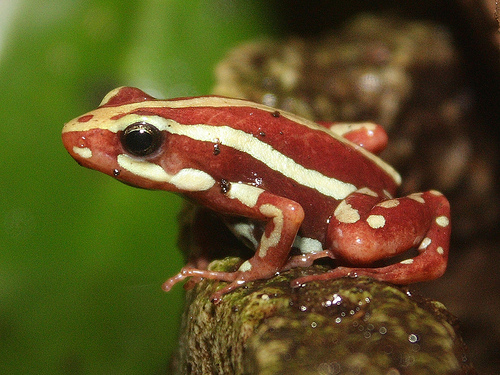
The Phantasmal Poison Frog or Phantasmal Poison-dart Frog isn't even as big as a 50-Cent Euro-coin. Nevertheless you can find him fast in his terrarium as he is of striking red colour. In combination with the three white stripes he shows a nice warning colouration which says: Don't touch! Poisonous! The poison-dart frogs are the second-venomous animals in the world coming right after the Zoanthids (a kind of anemone). Phantasmal poison frogs have one of the strongest toxins of frogs. Their toxicity is known to be lethal. One of commonly related organisms, the blue triden frog, is frequently mistaken for the Phantasmal poison dart frog. A phantasmal poison frog (Epipedobates tricolor) is a species of poison dart frog. Their natural habitat is the Andean slopes of the central Ecuadorian Bolívar province. They have radiant color, powerful poison, and yet are some of the smallest frogs around.


Phantasmal Poison Frog

Phantasmal Poison frog or Three-striped Poison Frog toxins come from the amphibian's diet synthesized  from toxic chemicals from the ants. millipedes and other poisonous invertebrates that the frogs eat. Captive-born poison frogs  don't have venomous skin secretions unless their diet has the poisonous invertebrates that the species normally eats in the wild. The  Aquarium staff has take pains to provide their phantasmal poison frogs with the proper diet assuring a high level of toxic secretions. The tiny frogs are part of a group of diverse amphibians known as "poison dart" or "poison arrow" frogs a description coined by Amazon explorers in the 19th Century. The frogs' venom was used by indigenous South American natives to coat darts projected by wind-driven devices called blowpipes.


Distribution-Central Ecuador
Habitat-tropical forest
Food-fruit flies, springtails
Social behavior-diurnal, strongly territorial
Characteristics-glaring red skin with three white stripes, small
breeding time: 14 - 21 days / 20 - 25 eggs
weight: 0 gramme
length: 1.9 - 2.7 cm

Phantasmal Poison Frog


Fascinating Facts
Through their skin, poison-dart frogs excrete a venomous alkaloid which they accumulated in their body by eating poisonous animals. The toxin is a convulsant poison that leads to respiratory and muscle paralysis and leads to dead within 20 minutes.
 
Endangerment
International Union for Conservation of Nature and Natural Resources - Endangered

Yellow Banded Poison Dart Forg Habitat and Reproduction

The yellow-banded poison dart frog is found in the neo-tropical region that includes Venezuela, northern Brazil, Guyana, and southeastern Colombia. They prefer humid or wet habitats and can be found on forest soil, moist stones, wet tree trunks, and roots of rainforest trees.

The yellow-banded poison dart frog is one of the largest species in this genus, with an adult body length averaging 1.57 inches. Their average weight is 0.11 ounces. Females are larger and more robust than males. They have distinctive yellow and black bands across the body. As the frog ages, the black bands often break off into spots. These frogs also have glandular adhesive pads on their toes and fingertips, which help them adhere to plant surfaces, allowing them to climb and cling. The bright coloration represents a warning of danger or distastefulness to potential predators. They produce toxic chemicals in their skin, making them poisonous to most would-be predators. Lifespan: In the Wild 5-7 years; In Captivity 10-15 years (record is 20.5 years).

Yellow-Banded Poison Dart Frogs


Behaviors
Yellow-banded poison dart frogs are diurnal (active during the day and rest at night), living mainly on the ground and also climbing into trees. Males are very territorial and can be aggressive in defense of a calling/breeding territory. When not breeding, they are solitary. The size of their territory is unknown. Males vocalize to attract females during breeding season. Males also use visual cues and show off their colors. They depend on vision to locate prey. Tadpoles use vibrations in water to signal their presence in a water pool to adult frogs. If a second tadpole is deposited, the first one will likely eat it. Enrichments at the Zoo: feeding, moving and changing furniture.

Reproduction
Yellow-Banded Poison Dart Frogs

Females reach sexual maturity at 2 years of age. Breeding occurs in February and March, occurring once
during the rainy season. During the mating season, males use vocalizations such as chirps, buzzes, trills, and hums to get the attention of females. Calling is most intense for an hour or two after sunrise and before sunset. They also show off their brightly colored bodies. Tactile (touching) communication is also important in breeding.

Females compete for males. After she chooses a mate, she follows him to his chosen breeding ground. She deposits her eggs (2-12 eggs in a clutch; up to 1000 in a breeding season) usually on leaves, in areas of high humidity. Then the male cares for the eggs, keeping them moist. Eggs hatch into tadpoles about 10-14 days after fertilization. He also cares for the hatched tadpoles. The tadpoles ride on the father’s back while he climbs up into the forest canopy, where he deposits the tadpoles into one of a variety of water-holding plants. Some reports say that he carries them in his mouth. Bromeliads are ideal for the tadpoles because they have many cup-like leaves filled with water. One tadpole is placed in each pocket of water. After 70-90 days, tadpoles have fully changed into froglets. They are mature at 12-18 months of age.

Conservation Status

IUCN status: not listed; CITES Appendix: not listed
Yellow-banded poison dart frogs are poorly known in the wild, but are common in captivity. Their numbers in the wild are declining due to exploitation and destruction of their habitat for lumber.
They are also collected for the pet trade. Predators: adults are preyed upon by some snakes, humans (many predators are obviously repelled by the toxic skin secretions); tadpoles are preyed upon by damselfly nymphs

Wednesday, May 25, 2011

Poison Dart Frog Amazing tail Colour

Poison dart frogs wear some of the most brilliant and beautiful colors on Earth. Depending on their habitats, which are from the tropical forests of Costa Rica to Brazil, their coloring can be yellow, gold, copper, red, green, blue, or black. Their designs and colors scare off predators. You may have seen monkeys carrying their children on their backs. Well, some of these frogs show some of these parenting habits, including carrying both eggs and tadpoles on their backs. These frogs are some of the most toxic animals on Earth. The two-inch-long Golden Poison Dart Frog has enough venom to kill 10 grown men. Indigenous people of Colombia have used its powerful venom for centuries to tip their blowgun darts when hunting.

BLUE POISON DART FORG

Scientists are not sure why these poison dart frogs are so poisonous, but it is possible they take in plant poisons which are carried by their prey, including ants, termites and beetles. Poison dart frogs raised in captivity and isolated from insects in their native habitat never develop venom. The medical research community has been exploring ways to use poison dart frog venom in medicine. Scientists have already used their venom to create a painkiller medicine.

Dyeing Poison Dart Frog

Strawberry Poison-Dart Frog

The Strawberry poison-dart frog, D. pumilio, is a tropical poison-dart frog found in the lowland Atlantic regions of Nicaragua, Costa Rica, and Panama (Reynolds et al, 2007). This anuran is a member of the family Dendrobatidae (Pröhl and Hödl, 1999) and a member of the pumilio group which contains two other dendrobatids; D. granuliferus and D. speciosus (Silverstone, 1975). The Dendrobatidae family contains approximately 170 described species and six genera, including Dendrobates (Claire et al, 2005). Some
anatomical characteristics include smooth or slightly granular skin, a round tympanum one-half the diameter of the eye, finger disks that are not sexually dimorphic, and a tarsal tubule that is only slightly developed if present at all (Silverstone, 1975).

Strawberry Poison-Dart Frog

D. pumilio inhabits lowland tropical wet forest zones and fruit plantations (Pröhl and Hödl, 1999) residing in microhabitats of fallen logs and bromeliads when in exposed areas (Silverstone, 1975). D. pumilio are terrestrial and diurnal frogs spending most of their time within 1 meter from the forest floor (Pröhl, 2002). Dendrobatids are active, diurnal foragers (Donnelly, 1991). Being terrestrial, the Strawberry poison-dart frog primarily feeds on small invertebrates which inhabit detritus material on the forest floor (Silverstone, 1975). Ants and mites which are available year round are the primary food source for D. pumilio. There are some dietary differences between adult Strawberry poison-dart frogs that could be a result of differences in behavior (Donnelly, 1991) which will be discussed in greater detail later in the paper.

Some physical characteristics include aposematic coloration, which, as in many other dendrobatids, serves as an effective signal to predators of their toxic skin alkaloids (Pröhl, 2002). There have been more than 80 alkaloids isolated from the skins of D. pumilio (Donnelly, 1989b). D. pumilio is unique regarding this aposematic coloration due to the fact that intraspecific differentiation in this frog is one of the most dramatic
cases of divergence among populations ever discovered (Summers et al, 1999); in regions of Panama, coloration can vary between the more common color of red or orange to blue, green, black, yellow and white and spotted and speckled patterns (Reynolds et al, 2007). There is usually only one color pattern in a given population (Silverstone, 1975).

GOLDEN Poison-Dart Frog

The throat coloration in males is usually darker than that of females and there are usually dark, black dots on the venter and dorsum (Silverstone, 1975). Like other Poison-dart frogs, D. pumilio exhibits elaborate social behavior; the species exhibits parental care and males are extremely territorial and aggressive (Donnelly, 1989a&b; Pröhl, 2002).

Reproduction and Parental Care

Among all of the anuran families, Poison-dart frogs are said to have the most elaborate social interactions (Donnelly, 1989a), which are seen most often during periods of mating. Mating is polygamous in D. pumilio; females and males mate several times with different mates during mating periods. This system of mating is associated with the tropical environment the frogs inhabit which prolongs availability of food, water and
other resources which allow females to continuously reproduce (Pröhl and Hödl, 1999). Courtship in D. pumilio takes approximately 10-98 minutes (Donnelly, 1989a) occurring on the forest floor during the day (Summers et al, 1999), usually in the morning (Pröhl and Hödl, 1999) and is initiated by the female who receptively approaches a calling male (Summers et al, 1999). The female will continue to approach the male and will often use tactile methods; she will stroke and nudge the male in approval (Reynolds et al, 2007; Summers et al, 1999).

Dyeing Poison Dart Frog

Encouraged by the female’s behavior, the male will continue to call and move away from her, eventually leading her to the oviposition site as she follows (Summers et al, 1999). Summers (1999) comments that females do not normally interact with other adults outside the context of courtship; D. pumilio is actually not a social species. Because D. pumilio is not a social species, Summers (1999) asserts that their
“courtship behavior provides an unambiguous assay of mate choice in this species”; when this frog does choose to interact with other frogs, it makes it easier to observe which frogs they prefer to associate with.

Once courtship has been initiated and the female has chosen the male, they deposit egg and sperm in a terrestrial moist location of the oviposition site while in a vent-to-vent contact (Donnelly, 1989a). Oviposition sites are usually in dense leaf litter on the forest floor (Donnelly, 1989a&b), which provides a moist microhabitat for the eggs to develop into tadpoles. Clutches are relatively small, averaging about 4.6 eggs per
clutch (Pröhl and Hödl, 1999). D. pumilio, like many Poison-dart frogs exhibit parental care from the male or the female in most species (Donnelly, 1989a). D. pumilio males attend to the eggs once they are fertilized (Donnelly, 1989a) by moistening them once a day (Pröhl, 2002), shedding water on them (Summers et al, 1997) until they develop into tadpoles, a process that takes approximately 10-14 days (Donnelly, 1989a). The males do not, however carry or feed the tadpoles (Summers et al, 1997) in their parental care.

Twitter Delicious Facebook Digg Stumbleupon Favorites More

 
Design by PlanetAnimalZone | Bloggerized by PlanetAnimalZone - PlanetAnimalZone | Animal and Pets Review