Showing posts with label Planet Dogs Breed. Show all posts

Sunday, July 3, 2011

German Shepherd Dog Highly Intelligent and History

German Shepherd Dog History

German Shepherd Dog

The German Shepherd Dog originated in the Alsatian Region of Germany. Today it is used world wide as a sentry, police dog, tracker, drug dog, search and rescue dog, and guide dog for the blind. The official name for this breed is German Shepherd Dog , though it is often called the German Shepherd or just Shepherd. For many years this was the only breed shown at AKC shows within the U.S.A. that had the word dog in its official name. The German Shepherd Dog is unique because it has a very short colon in comparison to other breeds of the same body weight. For this reason a high fiber diet is required to slow the movement of food through this breed's digestive track, thereby allowing more time for the nutrients to be drawn out. This high fiber diet will result in a larger stool but better assimilation of the food. I caution that this fiber must be from the proper sources and the amount should be carefully controlled. Too much fiber or fiber of the wrong type can cause impacted bowels.

The German Shepherd Dog's roots go back to the late 1800's in Germany where it was used as a shepherding dog. It was first known as the German Sheepdog, but during World War I the American Kennel Club renamed it the Shepherd Dog to reduce discrimination against the breed. In 1931 they restored the heritage back to the dog by naming it the German Shepherd Dog. By World War I the breed was already popular throughout Germany. It's enormous popularity never reached the shores of North America until the appearance of two movie stars by the names of Strongheart and Rin Tin Tin. Decades of movies and tv shows with German Shepherd Dogs assured their continued spot as the most popular dog breed in North America. It's popularity still continues to this day with AKC ranking it as the 3rd most popular breed!

German Shepherd Dog

German Shepherd Dog Breed Characteristics

The German Shepherd Dog is nothing short of a highly gifted dog. It's intelligence is the envy of most of the dog world. It is able to perform almost any task that man has asked of it, including guide dog, avalanche rescue, tracking, watchdog, police dog, drug and bomb sniffing, and it is still herding sheep in it's native homeland. German Shepherd Dog Highly intelligent, obedient, easy to train, protective, brave, and fiercely loyal are just some of the words used to describe this breed. Although high intelligence is often a sought after trait in a dog, it is not always a desirable one. Any prospective owner of a German Shepherd
Dog needs to assure that they are willing to put in the extra effort to mentally stimulate their new family member.

This breed needs to be involved in "extra-curricular" activities including early obedience. Consider joining a local club with your dog and you can both enjoy the benefits of activities like flyball, agility, advanced obedience, field trials, dog sledding, or Schutzhund. Giving your German Shepherd Dog "responsibilities" around the house will help to make your dog happier, and remember that "this breed only stops learning once we stop teaching".

German Shepherd Dog

The environment for the Alsatian Region of Germany provided this breed with primary food sources of beef, wheat, and leafy greens like cabbage and alfalfa. Thus, I recommend a blend of these food sources as the ideal base diet for the German Shepherd. Conversely, I feel the worst food blend for the German Shepherd Dog would contain fish, soy, or rice.

Friday, June 10, 2011

Whippet The Unique Body History breed and Breeders

The Whippet developed in Great Britain but originated in Italy or Northern Africa. Roman legions brought this breed to Great Britain when they invaded in 49 A.D.. The Whippet is the breed example I use when asked how long it would take a dog to change its nutritional requirements when exposed to different foods. My answer is that it would take as long as it would for a dog's coat to adapt to a new climate.

Whippet

After twenty-one centuries, the Whippet still has a coat best suited for the warm and dry environment of its origins and not the heavier double coat found on breeds originating in the colder climate of the British
Islands. Likewise, they still retain the nutritional requirements they developed in their native environment. Fortunately for the Whippet the rabbit was the main food supply in both their native area of the world and
in their new homeland.

Whippet
Native food supplies for this breed would have been rabbits, domesticated poultry, mutton, goat, and wheat or corn. For the Whippet I recommend foods that are a blend of lamb, poultry, wheat, and corn. The addition of a linseed oil coat conditioner to this blend will provide this breed with a good balance of the fatty acids its
skin and coat require. However, you should avoid feeding a soy oil coat conditioner to this breed as well as any soy bean meal in its food. Other food sources to avoid feeding a Whippet include horse meat, beef, or ocean fish.
Whippet

Weight Standards: m/f - average 25 lbs.
Height Standards: m - 19 to 22 inches, f - 18 to 21 inches
Coat: short and sleek, may be any color or color combination
Common Ailments: monorchidism, hot spots and skin rash

Tags: History Whippet, Whippet Puppy-Puppies, Whippet Breeds Standard and Breeders

Miniature Pinschers High Point Color and Breed

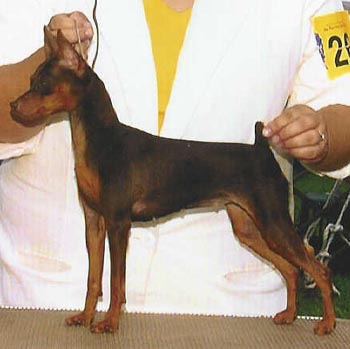
The Min Pinscher comes in six colors. Four of those colors show a solid base color with tan points, and two are solid red in appearance. The four base colors are black, chocolate (brown), blue, and fawn/isabella (lilac). The two other colors are stag red (sable) and red (yellow). The terms in parentheses are those used by color geneticists when talking about color, but for the purpose of this document I’ll use the common terms most Min Pinacher breeders and owners understand.

Miniature Pinschers BB or Black & Rust

‘B’ = Black and ‘b’ = brown/chocolate. Black is dominant over chocolate. So all dogs who are black will have ‘B’ in their genetic color code, and because ‘b’ is recessive to ‘B’, for a dog to be chocolate he must have two copies of the recessive chocolate gene, or ‘bb’ ‘D’ = NOT Dilute and ‘d’ = dilute. Dilute colors are blue and fawn. You can apply the same principles as above to the D series. Any dog with ‘D’ in its color genetics cannot be a dilute dog. Only when a dog inherits two copies of ‘d’ does it show the color of either fawn (dilute of chocolate) or blue (dilute of black).

All Miniature Pinschers have these basic four colors. Think of it as the base coat on your house or car. However, there are two other colors in the breed, and they can partially (in the case of Stag red) or wholly (in the case of clear red) mask, or cover, the underlying coat color. Like putting a top coat of paint on your house. You may change the color, but the base coat is still there. Solid colors also have Tanpoint. Along with the four base coats above, Min Pins, with the exception of those dominant for stag/sable, have tan point.

Miniature Pinschers Clear Red

The two solid red colors aren’t quite as similar as they appear.
Ay = Sable (stag red). Miniature Pinschers can be AyAy or Ayat. Dogs with Ay will be a russet red color (no visible points) with intermingling hairs. The color of the intermingling hairs is determined by the base color from the B/D series. Most have a base color of black (BB or Bb), which leads to black whiskers, a black nose, and black intermingling hairs, often visible on the side of the neck and the top of the back. However, if the dog is genetically a blue, chocolate, or fawn, the intermingling hairs will correspond to those colors, and the nose and whiskers will also reflect that base color (grey nose for blue dogs, chocolate nose for chocolate dogs, tan/beige nose for fawn dogs).

AyAy dogs are dominant for sable/stag and do not have tan points. Ayat dogs are stag/sable, but carry the gene for tan point. These dogs are often a darker stag color because they are letting in more of the base coat.
E = NOT yellow and e = yellow. Min Pins carry the EE/ee series. This is a masking gene. As long as there is one ‘E’ in the genetic makeup, the dog will not be clear red. But two copies of the gene, ‘ee’ will produce clear red and mask ALL other color. These dogs will be solid for one color, including whiskers. In these dogs, the only way to know what the base color was is to look at the nose and eyerim colors. This is the same gene which produces yellow labs.

Miniature Pinschers Chocolate and Rust

Though the Miniature Pinschers comes in all four colors, it’s important to note that blue and fawn Min Pins are not an allowed color in the United States. They can be registered, but cannot be shown. These two colors may be prone to a skin disease called Color Dilution Alopecia. When researching breeders, buyers should avoid any breeder who breeds specifically for color, or who refers to any color as “rare,” or “special.” Blue Min Pins are allowed in the UK.

Stag red, which is a form of sabling using the genetic color code of Ay, will partially cover the base colors shown on the previous page. Sabling means that the dog is a solid reddish brown but with an intermingling of darker hairs. Other breeds with sabling include Collies, Pembroke Corgis, etc. The color of the overlaying contrasting hairs depends on the base color shown on the chart on page two.  Miniature Pinschers can either be AyAy, dominant for sable, or Ayat, sable expressed but with a recessive for tan pointing. Those dogs who are Ayat are likely to appear as darker, richer stags because there will be more of the base color leaking through.

Miniature Pinschers Stag Red
Clear Red is caused by a masking gene, ‘ee.’ Because clear red masks all underlying color, the only way to tell which base color the dog is is through the skin color of the nose, eyerims, and footpads. Clear red dogs will be born a solid color, with no black hairs and with self-colored whiskers. Since clear reds turn up from all color combinations in Min Pins, it appears that the E/e series is present in all Miniature Pinschers.


Tags : Miniature Pinschers, Miniature Pinschers Breeders, Miniature Pinschers Puppies, Miniature Pinschers Pointer and Breed

Wire Fox Terrier Certain Essential Vitamins Minerals and Food dog

I have always advocated feeding the very best to your Wire Fox Terrier puppy for the first 6-12 months, because after that you can literally feed them whatever you like for the rest of their lives and they will usually still remain healthy. It is imperative to get the correct nutritional foundation In the Wire Fox Terrier puppy to ensure a long and healthy life. A lot of people think that fast foods or commercially processed dog foods - are the best and safest way of ensuring giving their dog all the correct nutrients the dog needs.

Wire Fox Terrier

This is far from the truth. Just like fast foods in humans they supply the basic essentials but also cause a lot of the same problems that bother humans: such as having too high a carbohydrate content so if fed ad lib the Wire Fox Terrier get too fat; they are often full of artificial colourings and E-numbers, which can lead to allergies and hyperactive behaviours; In many cases there is a lack of certain essential vitamins and minerals. Etc.

The dog food industry produce products catering to changing demands from the customers all dependant on which fads are in at the moment. An example of this being the variations seen in protein content in the various products available on the market. A researcher once said the dog needs a constant level of protein throughout in its diet-and with the exception of times when the dog is a puppy where the requirements are higher or in the times of illness where the requirements could be lower this demand does not alter.

Wire Fox Terrier

Another problem is that due to the very strong lobby in the human population against high fat diets for humans many of the commercial dog diets have now included low fat content for Wire Fox Terrier dogs (again marketing an incorrect product aimed at ignorant dog owners who have no idea what is good or bad for the dog) which again causes extremely dry coats and can cause severe scratching. I must repeat that dogs are carnivores and they would eat a high portion of animal fat. It is essential for their coats and for their energy and should not be removed from their diet. Also a majority of commercial foods tend to be too soft and lack the roughage when going through the intestines in comparison to the non commercial foods they should be eating and this softness can lead to dental plaque in the oral cavity, to anal gland problems and to constant digestive problems.

It is therefore imperative for everyone that own a dog to understand what the dog would eat if in the wild and to remember that they are NOT humans who are semi- herbivores but are carnivores who’s main ingredient in the wild would be of animal origin. They would eat the same as the wolves, the dingo and members of the wild cat family such as the lions and tigers.(I have never seen a zoo feed their lions and tigers with a full feed!

Modern research has found that a protein content of up to around 35%in a dog’s diet would be completely ok for most Wire Fox Terrier and dogs to eat. All the low protein diets available on the market play into the hands of ignorant dog owners who have been incorrectly informed (often by vets who sometimes use the term ”protein” poisoning which is a problem encountered in other animal species but most certainly not in the dog!

Wire Fox Terrier

The Wire Fox Terrier and dog in the wild would first and foremost eat products of animal origin as it’s main diet-and I have seen domestic dogs eat nothing else throughout their adult life and thrive on it. I cannot emphasise enough: REMEMBER the dog is a carnivore :

Another problem is that a large number of Companies making commercial foods for dogs try to find the cheapest source of protein as possible and soy beans have been used extensively throughout the industry as these beans are high in protein content and very cheap to produce and buy. However soy beans being a vegetable is not a natural food for the dog- and many breeds have reacted quite strongly to this. I have seen a number of Wire Fox Terrier dogs get very dry skin from this which has led to extensive itching and dermatitis.

Another cheap protein source though less used in commercial foods nowadays due to the increase in prices is fish- which alas has a nasty side effect although popular with the dog the more smelly fish have a terrible tendency to give a strong fishy smell which is secreted through the sweat glands in the skin. So although an occasional fish meal is excellent for the dog, not advisable to be used continuously.

Bones are also a very good source of protein not to mention the important minerals such as Calcium and Phosphorus (see under B). Some modern dog diets advocate dogs only eating raw bones-they say that the collagen in the bone when cooked is changed and not as nutritious as in the raw bone. This may well be correct but in our modern times some purchased meats and bones can be contaminated by harmful bacteria such as E-coli and salmonella, often contaminated through poor slaughter.


Tags: Wire Fox Terrier, Wire Fox Terrier handling and problem, Wire Fox Terrier Vitamin, Health, Minerals and Food Dog

Wirehaired Pointing Griffon Breeds Care and Food Suplemen

The Wirehaired Pointing Griffon originated in Holland and then developed further in France. Holland, now known as The Kingdom of the Netherlands, is a small European coastal country, north of France and east of Germany. Its highest elevation is 1000 feet and its lowest elevation is 20 feet below sea level. Holland's extremely fertile land and extremely wet climate produced a breed of dog that has one of the most unique coat fibers found in the canine family. This breed's coat, though relatively short, insulates the dog's body better than many fine textured long double coats found in the Nordic Spitz breeds.

Wirehaired Pointing Griffon
Yet this coat requires stripping and the texture is like that found in many terrier breeds from other climates. This coat, found only on the Wirehaired Pointing Griffon, is one way this breed is different from other breeds of canines. The differences among this breed and others also extend to its nutritional requirements.Native food supplies found in their original coastal and lowland environment would have been oats, potato, rye, sugar beets, and wheat. Meats were from domesticated poultry, dairy cattle, and ocean fish of the North Sea.

For the Wirehaired Pointing Griffon I recommend foods that contain ocean fish, poultry, and dairy products blended with potato, oats, and sugar beet. I also recommend that you avoid feeding yellow corn, avocado, soy bean meal, or horse meat to this breed.

Wirehaired Pointing Griffon


Tags: Breed Wirehaired Pointing Griffon, Wirehaired Pointing Griffon, Wirehaired Pointing Griffon Breeders Care Maintenance

Xoloitzcuintli Best Dogs and Breeds Care

Xoloitzcuintli
One of the world’s oldest and rarest breeds, the Xoloitzcuintli (pronounced show-low-eets-queent-lee) can be called the first dog of the Americas. The name is derived from the Aztec god Xolotl and the Aztec word for dog Itzcuintli. Highly prized for their curative and mystical powers, a reputation that persists to this day, the Xolo held a place of special religious significance for many ancient cultures. Clay and ceramic effigies of Xolo’s date back over 3000 years and have been discovered in the tombs of the Toltec, Mayan, Zapoteca and Colima Indians. There are three sizes: Toy, Miniature and Standard. The miniature and standard Xolo’s were first registered in Mexico in 1955. Before then, the breed was kept alive by secluded Indian tribes in remote parts of Mexico and South America. The Countess Lascelle De Premio Real was primarily responsible for the reestablishment of this almost extinct native breed, which is now designated as the official dog of Mexico.

 General Appearance: A Xoloitzcuintli dog of clean and graceful outline, equally combining elegance and strength. There are two varieties: coated and hairless. In the hairless variety, the principle characteristic is the total or almost total absence of hair. In the coated variety, the hair should be short, dense and flat. In Conformation, the Xolo is lean and well proportioned, somewhat like a Manchester Terrier.

General Appearance: A Xoloitzcuintli dog of clean and graceful outline, equally combining elegance and strength. There are two varieties: coated and hairless. In the hairless variety, the principle characteristic is the total or almost total absence of hair. In the coated variety, the hair should be short, dense and flat. In Conformation, the Xolo is lean and well proportioned, somewhat like a Manchester Terrier.

Coat, Skin, Colour: The principle characteristic of the hairless variety is the absence of hair in general, but the presence of a tuft of short coarse, and not very dense hair on the head and nape is acceptable. It is also common to have similar hair on the feet and tail. Hair on areas other than the head, nape, feet and tail is a serious fault. Skin is smooth, firm, sensitive to the touch and seems to radiate heat. Scars caused by accidents should not be penalized.

In the coated variety the hair is short, dense and lies flat on the body, completely covering all areas of the dog. Solid colour dogs and dark shades are preferred. Colours may range from black to grey, red, liver, bronze to golden yellow. Particolours occur, including white patches. Solid colours and darker shades are preferred. Long soft or wavy hair in either variety is a serious fault.

Head: Expression is thoughtful and intelligent, showing distinctive brow wrinkles when at attention. The expression is of a vivacious animal, conveying the noble and faithful character of this breed. Eyes should be almond shaped and of medium size, neither sunken nor protruding.. Both eyes are the same colour, which varies from yellow to black, the darker being preferred. The eye rims are dark on dark coloured dogs and may be lighter on light coloured dogs. Ears are large, expressive and elegant, set medium high and carried erect when alert. The ear leather is to have a thin and delicate texture. Ears not standing erect at one year
of age, is a fault. Cropping is prohibited. Skull is wedge-shaped. Stop is not pronounced. The muzzle is slightly longer than the skull, with strong upper and lower jaws.

Xoloitzcuintli

The jaw line blends smoothly into the muzzle. The nose is black on dark coloured dogs and may be lighter on light coloured dogs. Lips are thin and tight, cheeks are barely developed. The bite is a tight scissors bite. Overshot or undershot is a serious fault. In the hairless variety the absence of premolars is to be expected and the absence of molars is not to be penalized. A complete set of incisors is preferred but lack thereof not to be penalized. In the coated variety full dentition is required. Moderate wrinkling on the heads of adults is acceptable.

Neck: The neck is long and slightly arched, blending smoothly into the shoulders. The skin is without wrinkles or dewlap, though in young dogs under one year of age wrinkled skin may still be present.

Forequarters: Seen from the front, the front legs are straight, vertical, in good proportion and of good length in relation to the body. The shoulders are flat and muscular, the length of shoulder blade and upper arm are also of good length and proportion in relation to the body. The moderate angulation of shoulder blade and upper arm permits free and reaching movement. The strong elbows fit close to the chest wall, never turned outward (elbowing out). The feet are hare feet, webbed with tight well arched toes. Pads are firm and elastic. Nails are short and black on dark coloured dogs and may be light on light coloured dogs. Dewclaws may be removed. The feet may have a small bristly hair, and neither toe in nor out.

Body: The body is well developed and strongly built. From the front the forechest is adequately broad but the tip of the sternum does not protrude. The brisket reaches the point of the elbow, ribs are well sprung but not barrel shaped. The top line shows not very well defined withers, a straight level and firm back and loin, strong and muscular having a slight arch. The croup is gently rounded, muscular and relatively broad. The underline is elegant, beginning under the chest and following the muscular tucked-up belly in a rising line.

Hindquarters: Seen from the back, the hind legs are straight and parallel with strong well muscled thighs, standing wide rather than close. Stifles moderately bent, hocks straight, turning neither in nor out, with well let down angulation of proportionate degree to permit free strong driving movement of the hindquarters. Feet and nails are the same as front. Dewclaws may be removed. Cowhocks are a serious fault.

Tail: The tail is long and thin and may have some bristly hair. Set on low, reaching to the hock, and tapering towards the tip. In movement it is carried high, curved, never curled over the back. In repose, it hangs down in a slight curve.

Gait: The Xolo has a long, elegant, springy step, a free and effortless fast trot, with a double tracking movement. The legs converge towards a centre line as speed increases but do not single track. Head and tail are carried high.

Friday, April 29, 2011

Irish Terriers The Muscular Dogs and Gentic DNA

The Irish Terrier was once known as the Irish Sporting Terrier in its native Ireland. The group of dogs collectively labeled the "Irish Sporting Terrier" included a rather mixed looking group of dogs with no breed standards. Breeders established standards after a show in Dublin, Ireland, in 1875, and the dogs conforming to these standards became the forefathers of today's Irish Terrier. The first records of this breedindicate they were a ratter and an upland game bird dog. They are very quick and agile and can catch a rabbit on the run or a woodcock before it can take wing.

OWING to their great pluck, Irish Terriers are known among their friends as daredevils, and no breed is more worthy of this sobriquet. While being good-tempered with human beings, they are never averse from a scrap with other dogs if the challenge is thrown down. They make very devoted companions, and are excellent guards, meeting the needs of any who require a Terrier between the Fcx Terrier and Airedale in size. The most desirable weight is about 27 lb. for a dog and 25 lb. for a bitch. They are somewhat higher on the leg than Fox Terriers, and also more racily built.

Irish Terriers

They are expected to present "an active, lively, lithe, and wiry appearance; lots of substance, at the same time free of clumsiness, as speed and endurance, as well as power, are very essential." Front legs should have plenty of bone and muscle, and should be quite straight. Shoulders long and sloping, and chest deep and muscular without being full or wide. The back is moderately long, and it should be strong and straight. Loins bioad and powerful, and slightly arched; ribs deep rather than round. The neck is a fair length, and the head is long, with a skull that is flat, and rather narrow between the ears, which are small and V-shaped. Eyes a dark hazel colour, small and not prominent. Whole coloured bright red, red-wheaten, or yellow-red, are the preferable colours, and the coat should be hard and wiry.


For the Irish Terrier I recommend foods containing potatoes, wheat, rye poultry, mutton (lamb), and fish. I also recommend that you avoid feeding an Irish Terrier any white rice, brown rice, avocado, or soy products. Native food supplies of Ireland for this breed would have been the potato, wheat, rye, flax, game birds of the woodcock variety, fish, and mutton. So when considering the food for this breed, remember the ingredients that would have gone into Irish Stew. These ingredients represent the food supplies that have been in Ireland for centuries. Also remember the number of rice paddies you can find in Ireland is zero.

Irish Terriers Highly Jump

A research program on footpad hypekeratosis, also called naso-plantar keratoderma, is ongoing in the
laboratories of CNRS-University of Rennes I (Dr Catherine André, Rennes, France) and Antagene (Dr Anne Thomas, Lyon, France), since november. This disease affects both the Irish Terriers and the Dogues de Bordeaux. In order to unravel the genetic causes of the disease in both Irish Terrier breeds, collecting cases and having side by side clinical and epidemiological data in the 2 breeds will strongly help for their comprehension.

1. Clinical signs are well described in Dogue de Bordeaux :
- hyperkeratosis of footpads (usually on the four paws), and sometimes of the nose. Some dogs are
only affected on nose,
- age of onset between 4 and 9 months old (after one year old, a dog could be considered as healthy)
- the disease is disabling for young dogs and slightly ameliorates with the age

2. Inheritance in both breeds is suspected to involve one gene and to be autosomal recessive.

In order to better characterize the clinics and the genetic causes, a research program is pending with
the collaboration of veterinarian surgeons specialised in Dermatology, geneticists and the help of
breeders and kennel clubs. For research purpose, we need DNA from affected and healthy dogs:

- A blood sample (on EDTA tube) or a cheekswab sample (kits are available from Antagene)
- A copy of the pedigree
- Sampling and clinical certificates (available on www.antagene.com)
- For affected dogs, an histopathological examination is major to confirm the diagnosis, it will allow to
exclude any other cause.

Irish Terriers

The ultimate aim of this research is to finalise a genetic test to determine if the dog is  healthy carrier  or  affected by the disease with a simple DNA sample obtained from blood or cheekswab. The early detection of carrier dogs will allow a better management of breeding by avoiding production of affected dogs and eventually decreasing the frequence of the disease in those breeds. In addition, this disease exists in human, all forms are not genetically understood, and the results of this genetic study in Irish Terrier dog will help human medicine to identify the responsible genes, or to explore common pathways between human and dogs.

Monday, April 11, 2011

GROMMING IRISH SETTER BEST CHAMPION SHOW DOG

The Irish Setter's origins remain a mystery. We do know they became popular in Ireland soon after they first appeared there a few centuries ago and that most of today's Irish Setters can trace their linage to Irish kennels. They became popular because their performance as upland bird dogs was unparalleled. They are the tallest of the setters and one of the most handsome. The Irish Setter requires large amounts of fats, as well as a high carbohydrate to protein ratio in its base diet. It will produce a very healthy and shiny coat when the proper balance of fat-to-carbohydrateto protein is provided. The source of the fat in the Irish Setter's diet is very important. The best sources would be from vegetable sources and the worst would be from animal sources, such as beef fat.

IRISH SETTER

This is due to the different sources of fats containing different amounts and ratios of the alpha-Linolenate family. When feeding the Irish Setter, just think of the ingredients for grandma's Irish Stew. These ingredients represent the food supplies found in Ireland for centuries. I think the best food blend for the Irish Setter should contain potatoes and other vegetables such as carrots, rye grains, with meat sources of lamb and poultry. Conversely, I think the least desirable blend would contain horse meat or beef and their by-products, with soy, fish, or rice.

For Irish Setter's those of you who do not know me, I am a professional Canine Beautician of over twenty years I run my own High Street Grooming Salon in Leicester, apart from pet dogs we also have a regular clientele of many breeds of show dogs, and together with our Thendara Irish Setters, I also own and show Afghan Hounds, the ultimate challenge in coat care and presentation! It is important to remember when reading the following that these are my opinions, others may do it differently with equally good results, and there are those that sculpturing and preening of coats is objectionable.

My view is that today’s show IRISH SETTER dog has to be presented to advantage if one wants to compete at the highest level, take a close look at any group at a general championship show, note the top IRISH SETTER, look at their presentation, believe me, they were not just thrown in the bath the night before and quickly hacked at on the bench before their class!

IRISH SETTER

Regardless of how much long feathering the individual dog carries, the crowning glory of the Irish Setter is his unique and beautiful red coat, which should gleam like a new conker. Length and quality of coat is genetic, I do not believe there is anything you can feed to a dog which will make its coat grow longer than its own genetic make up will allow. IRISH SETTER Coat condition is dictated by the animals general health and diet, how it is cared for and seasonal changes, some will moult in the summer months, and the majority of bitches are difficult to keep in condition when they come into season or after a litter, most will drop a lot of coat around that time and the condition will be lost for a while. When my own Bitches are dropping coat, I bath them every few days and brush and brush until all the dead hair is removed, the sooner its gone the sooner the new hair will start to come through.

From the many questions I am asked the main concern for a lot of exhibitors is how to accomplish trimming, but before I go into that lets look at something far more important. BATHING. I do not hold true with the belief that to regularly bath a dog will ‘ruin its coat’,’ is not good for it’, or ‘will wash all the oil from the coat’. ‘Get real’ you cannot change how your dog is made but you can ensure its presentation can compete with the best, learn to cherish every hair.

Never brush or comb the long feathering hair when dry, especially when dirty. Always shampoo and condition first and brush out when towel dried. This should be done at least once a week, or on a male dog it should be done every 3 days. When brushing out at a show always mist the coat first with water.

Every IRISH SETTER coat is different, so trial different products until you find one that suits. You will probably find you will need to use a different shampoo and conditioner on the body to that of the feathering. If your IRISH SETTER dog has thick strong hair with a course feel to it and or a certain amount of wave in the top coat, use a shampoo and conditioner that is rich, such as Plush IRISH SETTER Puppy conditioning shampoo with evening primrose or one made for long flowing coated breeds i.e. Afghans, Llasa Apso etc. Where the feathering is fine use a much lighter shampoo, Plush IRISH SETTER Puppy Body Building shampoo will help boost the volume without flattening the hair, if conditioner is still required use a very diluted, silk protein conditioner. To use something richer as those mentioned above will make fine hair lank.

On the head and body I prefer to use something like Plush IRISH SETTER Puppy’s all purpose shampoo with henna, it gives a great shine, or if there is a build up of conditioning products and or dirt the best clarifying shampoo is Plush Puppy Deep Cleansing shampoo, Which will leave a gleaming coat. When shampooing it is imperative to saturate the dog with warm water, for the first wash dilute your shampoo and rinse through the coat, shampoo the head and body first with your chosen body shampoo and rinse thoroughly now work in the conditioning shampoo through the feathering and rinse out.

 
IRISH SETTER Weight Standards: m - 70 lbs.; f - 60 lbs.
Height Standards: m - 27 inches; f - 25 inches
Coat: Long, flat, silky coat with feathering, Mahogany
Common Ailments: hip dysplasia, bloat, PRA

Cover the entire feathering in conditioner, if there are any tangles work out with your fingers and then brush through with a bristle brush, (wet hair can take far more punishment than dry) dilute some more of the conditioner and pour over the body and rinse out until the body feels squeaky clean, then gently rinse out the remaining conditioner through the feathering until you can feel just a trace left. Squeeze excess water from the coat and towel dry.

I recommend only two types of brush to be used on a show coat the first is a good quality bristle or bristle and nylon type, although expensive I find the best is a Mason & Pearson, the second is a good quality cushioned pin brush. Combing should be done very carefully and only on fully brushed out hair. After towelling start brushing out the long hair with the pin brush, always start from the ends and work up towards the body, use the bristle brush on the body. If you intend to blow dry the coat wait until the coat is just damp, blow-drying very wet hair will knock the body from it.

If your IRISH SETTER dog has quite a short flat body coat, leave to dry naturally, or with maybe just a little warm air being brushed through in the wrong direction this will lift the roots slightly and give more movement to the coat. On thick or wavy types blow dry thoroughly brushing the coat downwards as you go. Now go on to drying the feathering, I start with the front legs working with the brush from the bottom of the leg, brushing each section until dry working up towards the body, I then usually go on to the chest area back legs and tail and finishing on the more delicate under body hair. The coat can then if needed be gently combed into place.

When maintaining IRISH SETTER the coat between shows always use a clarifying shampoo to remove excess conditioning products, oils and other maintenance products, grooming sprays and dirt, then go on to the conditioning shampoo rinse thoroughly and then saturate in conditioner and rinse but leaving some still in, the coat should feel rinsed but slick, alternately a leave in oil treatment such as Plush Puppy Sea Breeze Oil can be used, follow their instructions.

Sunday, April 10, 2011

Harrier Colonial Hunters Dogs and Recommended Foods

The Harrier that we know today developed in England in the early 1200's and has one of the cleanest family tree records of any hound. Since there is an occasional puppy born with unusual coat coloring,
there is a debate about the origins of the breed prior to the time records were kept on the first pack of Harriers. For five centuries we know this breed's breeding was confined to one pack, owned by a single family. The Virginia Colonial hunters used this excellent scent hound for tracking bear, boar and deer before we became a nation. They work well in a pack when hunting and have gained a good deal of respect from hunters in the southern states for their good nose and tenacity.

Harrier

Harrier Dog Developed in England to hunt hare in packs. Harriers must have all the attributes of a scenting pack hound. They are very sturdily built with large bone for their size. They must be active, well balanced, full of strength and quality, in all ways appearing able to work tirelessly, no matter the terrain, for long periods. Running gear and scenting ability are particularly important features.

Harrier Head
The head is in proportion to the overall dog. No part of the head should stand out relative to the other parts. The expression is gentle when relaxed, sensible yet alert when aroused. Eyes are almond shaped, medium size, set well apart, brown or hazel colour in darker dogs. Lighter hazel to yellow in lighter dogs, though darker colours are always desired. Ears are set on low and lie close to the cheeks, rounded at the tips. The skull is in proportion to the entire animal, with good length and breadth
and a bold forehead. The stop is moderately defined.

The muzzle from stop to tip of nose is approximately the same length as the skull from stop to occiput. The muzzle is substantial with good depth, and the lips complete the square, clean look of the muzzle, without excess skin or flews. A good nose is essential. It must be wide, with well opened nostrils. Teeth meet in a scissors bite or they may be level. Overshot or undershot bites faulted to the degree of severity of the misalignment.

Harrier

Harrier Body
The topline is level. Back muscular with no dip behind the withers or roach over the loin. Chest deep, extending to the elbows, with well sprung ribs that extend well back, providing plenty of heart and lung room. The ribs should not be so well sprung that they interfere with the free, efficient movement of the front assembly. The loin is short, wide and well muscled.
Harrier Dog Temperament
Outgoing and friendly, as a working pack breed. Harriers must be able to work in close contact with other hounds. Therefore, aggressiveness towards other dogs cannot be tolerated.

Harrier Size, Proportion, Substance
Size-19 to 21 inches for dogs and bitches, variation of one inch in either direction is acceptable. Proportion is off square. The Harrier is slightly longer from point of shoulder to rump than from withers to ground. The body is solidly built, full of strength and quality. The breed has as much substance and bone as possible without being heavy or coarse.

Harrier

Harrier Coat and Colour
Coat Short, dense, hard and glossy. Coat texture on the ears is finer than on the body. There is a brush of hair on the underside of the tail. Colour Any colour, not regarded as very important.

Harrier Neck
The neck is long and strong with no excess skin or throatiness, sweeping smoothly into the muscling of the forequarters.

Harrier Forequarters
Moderate angulation, with long shoulders sloping into the muscles of the back, clean at the withers. The shoulders are well clothed with muscle without being excessively heavy or loaded, giving the impression of free, strong action. Elbows are set well away from the ribs, running parallel with the body and not turning outwards. Good straight legs with plenty of bone running well down to the toes, but not overburdened, inclined to knuckle over very slightly but not exaggerated in the slightest degree. Feet are round and catlike, with toes set close together turning slightly inwards. The pads are thick, well developed and strong.

Harrier Tail
The tail is long, set on high and carried upwards. It tapers to a point with a brush of hair.

Harrier Gait
Perfect coordination between the front and hind legs. Reach and drive are consistent with the desired moderate angulation. Coming and going, the dog moves in a straight line, evidencing no sign of crabbing. A slight toeing-in of the front feet is acceptable. Clean movement coming and going is as important as side gait, which is smooth and ground-covering.”

For the Harrier I recommend foods that are a blend of horse meat, beef, and small amounts of poultry blended with wheat, oats, and yellow corn. Since you may not be able to find this recommended blend in any one commercial food, you may need to blend two foods to achieve this mix. I also recommend that you avoid feeding a Harrier any fish, beet pulp, soy, or white rice. Native food supplies that were available to this breed in their developing years would have been meats from fox, deer, and boar. Primary vegetables were the low ground type and grains were rye and wheat.

Greater Swiss Mountain Dog The Strong and Climbers Dogs

The Greater Swiss Mountain Dog developed in the mountains of Switzerland in Central Europe. They have a history that dates from the time of Julius Caesar. They were draft dogs, herding dogs, watch dogs, and even battle companions. Nicknamed the "Swissy", it is one of four breeds known as the Swiss Sennenhunde (the four being the Swissy, Bernese Mountain Dog, Entlebucher, and Appenzeller). The Greater Swiss Mountain Dog is a very thick boned and heavily muscled animal, which can develop slower than other breeds. The thick bones and heavy muscles contribute to this breed's unique nutritional requirements. Therefore, the Greater Swiss Mountain Dog should be kept on a diet that will provide the proper nutrients for the development of bone and muscle tissue until fully developed. This can be long after the breed has reached its exterior adult body size.

Greater Swiss Mountain Dog Breedeers

Greater Swiss Mountain Dog

Greater Swiss Mountain Dogs are a large breed and require space. They also require moderate activity and regular exercise. A true working breed, the Greater Swiss Mountain Dog is most content when he has a job or purpose. Greater Swiss Mountain Dog are not lazy, lay around-the-house dogs. Swissys are most content in the company of their families. They are not well suited to kenneling and confinement away from the activities of the household. Though capable of withstanding the elements, the Greater Swiss Mountain Dog nature is best suited to being a family member and house companion. Swissys are alert and vigilant. This means that they will bark at neighbors, guests, and just about anything going on in the neighborhood! They have a natural protective instinct to guard home and family.

Greater Swiss Mountain Dog have several major health problems to consider. In addition to the common orthopedic ailments of large breeds, such as OCD and hip dysplasia, the GSMD is afflicted by a very serious condition known as Gastric Dilation Volvulus, or "bloat". This is a life-threatening medical emergency that is all too common in our breed. Epilepsy is another very serious health concern. All of these conditions can be costly to treat and manage. Greater Swiss Mountain Dog are strong dogs! They are powerful in physical strength and strong-willed and can often be a challenge to leash train. Greater Swiss Mountain Dog love to pull. Keep in mind that children (and for that matter some adults!) may have a difficult time walking a Swissy throughout the neighborhood. Because many Greater Swiss Mountain Dog have a well developed prey drive, they require a fenced yard for safe containment. A neighbor's cat or unsuspecting squirrel can become the target of chase!

Greater Swiss Mountain Dog

Greater Swiss Mountain Dog temperaments vary but are overall quite complex due to their working dog nature and development. Greater Swiss Mountain Dogs are NOT a good choice for inexperienced or first time dog owners. In the hands of an experienced owner, the Swissy can be a wonderful family companion. Greater Swiss Mountain Dogs were originally bred as draft and guard dogs. Like many working breeds, the Swissy has a tendency for dominant temperaments and behaviors. In addition, Greater Swiss Mountain Dog tend to be "social climbers".

Practicing effective pack leadership is necessary to prevent dominant behaviors from becoming problematic. Greater Swiss Mountain Dogs must learn their place in the family social hierarchy. This takes time, effort and a good dose of patience. GSMDs require diligent socialization at an early age. This means meeting many new people and being introduced to many new situations. Socializing a Swissy is a commitment not to be taken lightly. Some GSMDs may exhibit dog aggression, particularly intra-sex aggression in intact animals.

Greater Swiss Mountain Dog are slow maturing both mentally and physically. Because of orthopedic concerns related to large breed dogs, great care must be taken to prevent injury during growth stages. Despite their sturdy build, the breed is, in effect, quite fragile during these growth periods. The Greater Swiss Mountain Dog is not a breed that can sustain unlimited exercise or activities such as jogging at a young age.

Greater Swiss Mountain Dog Weight Standards: m/f - 120 to 140 lbs.
Height Standards: m/f - 25 to 28 inches

Coat: double, thick long topcoat, black with bronze & white
Common Ailments: dysplasia, bloat, hot spots,
kidney and liver problems

For the Greater Swiss Mountain Dog I recommend foods that contain poultry, lamb, wheat, oats, and corn. However, I feel you should avoid feeding a food that contains any ocean fish, citrus fruits or avocado, white rice, or soy products to this breed. Native food supplies for this breed would have been from the mountain environment of the Swiss Alps. These consisted of mutton, poultry, goat, goat dairy products, and grains of wheat, oat, and corn.

Great Pyrenees Best Body Guard and Mountain Dog

The Great Pyrenees developed in the Pyrenees mountains, on the border between France and Spain. This breed is one of the oldest domesticated breeds of dog with a history that has been traced to the
Bronze Age (3500 to 4000 BC.). At that time it was used in its native environment for much the same purpose that it is used today; that of living in harmony with large flocks of sheep while protecting them from the bears and wolves. They possess great stamina, a keen sense of danger, and good fighting abilities. Due to its growing popularity, the Great Pyrenees Club of America has a code of ethics clause. Members will guarantee any puppy they sell to be free from hereditary defects to protect this breed. I applaud these people in their efforts to provide us with good and healthy dogs.

Great Pyrenees History
The Great Pyrenees is native to the Basque country in the Pyrenees mountains that border France and Spain. Known as Le Chien de Montagne des Pyrénées in its native France, the Great Pyrenees is known to be one of the oldest breeds of dog in the world. While similar in size and stature to the Mastiff family, the Great Pyrenees is actually descended from the ancient large, white livestock guardian dogs of the middle ages and therefore evolved parallel to most modern breeds of dogs as opposed to being descended from them. Because of this, the Great Pyrenees has more in common with a wolf, than that of a modern dog. Having no extant ancestor, the Great Pyrenees has remained virtually unchanged both physically and mentally for hundreds of years.

Great Pyrenees

This has allowed it to evolve naturally over centuries, which among other things, means that the breed has relatively few health problems, in comparison to modern dogs. The first written reference to the Great Pyrenees is from 1407, where the historian of the Chateau of Lourdes wrote of the breed in use to guard the Chateau.

The Great Pyrenees is native to the Basque country in the Pyrenees mountains that border France and Spain. Known as Le Chien de Montagne des Pyrénées in its native France, the Great Pyrenees is known to be one of the oldest breeds of dog in the world. While similar in size and stature to the Mastiff family, the Great Pyrenees is actually descended from the ancient large, white livestock guardian dogs of the middle ages and therefore evolved parallel to most modern breeds of dogs as opposed to being descended from them. Because of this, the Great Pyrenees has more in common with a wolf, than that of a modern dog.

Having no extant ancestor, the Great Pyrenees has remained virtually unchanged both physically and mentally for hundreds of years. This has allowed it to evolve naturally over centuries, which among other things, means that the breed has relatively few health problems, in comparison to modern dogs. The first written reference to the Great Pyrenees is from 1407, where the historian of the Chateau of Lourdes wrote of the breed in use to guard the Chateau.

Great Pyrenees

Great Pyrenees Working Dog

The Great Pyrenees is a working animal, bred primarily as a livestock guardian for shepherds. Their imposing size, strength , courage and resistance to the elements proved invaluable to shepherds, who learned to depend on the large white dogs for companionship as well as protection for their flock against predators of all kinds. Wild dogs, bears, wolves, coyotes, as well as many birds of prey and more, learned to respect the white dogs and give them a wide berth. Even humans, over the ages that threaten or endanger their flock have found themselves on the wrong side of a Great Pyrenees. The breed's natural characteristics are a calm, placid nature, which was a work requirement allowing them to roam freely among the flocks without alarming them.

Upon sensing a threat to its flock or family however, the Pyrenees is 100% a fearless guardian dog, quite capable of convincing nearly any predator that dining on its flock is not an option. The Great Pyrenees' heavy, white double coat is a valuable asset, shielding the dog from rain, wind and snow as well as providing a formidable coat of armor against the teeth of predators.

Great Pyrenees Weight Standards: m - 100 to 125 lbs., f - 90 to 100 lbs.
Height Standards: m - 27 to 32 inches, f - 25 to 29 inches
Coat: double with heavy undercoat, long soft solid white top coat
Common Ailments: dysplasia, hot spots and skin rashes,
liver and kidney failure

Also known as the Great Pyrenees Mountain Dog in much of Europe, the Great Pyrenees is a highly intelligent and independent breed. It requires no human intervention while in the field, which was a requirement as early Pyr's often protected hundreds of acres of open farmland, fending off any predators it encountered. The working Pyr makes its own decisions and acts on them accordingly. The breed is also known for its natural ability to sense danger, with many a shepherd throughout time owing their lives to their big white companions.

Great Pyrenees Recommended Foods

Native food supplies for this breed would have been from their Pyrenees Mountain environment. The meat sources contained a very high fat to protein ratio. Any grains or vegetables would have been the type that could grow in a short season and rocky soil. For the Great Pyrenees I recommend foods of lamb, poultry, wheat, and potato. It must have a high fat content. I also recommend you avoid feeding a food that contains soy, beef or beef by-products, yellow corn, or beet pulp to this breed.

Great Dane High Quality Breeders Genetics DNA

Great Dane Breeder

If Great Dane breeders could predict canine coat color, they would be able to make breeding decisions much easier. Through techniques such as DNA testing and gene mapping, scientists are learning insightful information about coat color in dogs that challenges long-held beliefs. Even so, the genetic complexity of canine coat color is filled with surprises. Great Dane breeders can contribute to genetic research on coat color as well as other traits, Schmutz says. She attributes much of the coordination of Great Dane DNA studies currently under way to J.P. Yousha, owner of Chromadane Kennel in Texas and Chairman of the Health and Welfare Committee of the Great Dane Club of America. Yousha also helped Schmutz to understand the terms many Dane owners use when describing their dogs’ coat colors and patterns.

Great Dane Breeder Early Coat Color Genetics

Great Dane Nearly 50 years ago in 1957, Clarence Little wrote “The Inheritance of Great Dane Coat Color in Dogs.” His text, which became a classic on coat color, contains information Little obtained from breeders and from his own crossbreedings of dogs of different coat colors. Little developed several hypotheses on the number of genes and alleles that determine coat color. Little labeled the positions, or loci, of coat color on paired chromosome as: A for agouti, B for brown, C for albino, D for blue dilution, E for extension, G for graying, M for merle, R for roaning, S for white spotting, and T for ticking. Little’s work continues to provide valuable reference material to scientists today; however, new technologies are helping to enrich understanding about coat color genes.

Great Dane
Weight Standards: m - 135 to 150 lbs., f - 120 to 135 lbs.
Height Standards: m - over 30 inches, f - over 28 inches
Coat: short, smooth with a harsh texture,
in colors of brindle, fawn, harlequin or solid black
Common Ailments: bloat, torsion, dysplasia, spinal disc problems

At the University of Saskatchewan in Saskatoon, Canada, and Stanford University in California, researchers have found that Little’s E locus contains three alleles red (e), black (E) and the variant that causes masking (EM) rather than the four alleles red, black, mask and brindle that Little described. It appears that Great Danes are either E or EM and do not carry e.

The finding by Sheila Schmutz, Ph.D., professor of animal and poultry science at the University of Saskatchewan and her colleagues is significant for breeders of dogs in which masking is important, such as in brindle and fawn Great Danes. Schmutz’s group refers to Little’s E locus as the melanocortin receptor 1 gene (MC1R), named for the gene’s protein. “Our MC1R studies are a good example of how DNA studies are proving Little both right and wrong,” Schmutz says. “In a few breeds of dogs, a black mask appears to be a fixed trait, but that’s not the case with Great Danes,”

Schmutz says. “In Danes, masking is a dominant trait that, when present, is visible on dogs with fawn and brindle coats. However, the dominant mask trait also can be carried by black or blue Great Danes and harlequins and merles it’s just not noticeable in these dogs because of their dark coloring or spotting pattern.” Little’s work, which came before DNA testing, is based on hypothesized alleles at hypothesized loci to fit data obtained from coat colors and patterns of dogs from various breeds and litters, Schmutz says. “DNA research has shown that there are more genes involved than those hypothesized by Little and that the actual number of alleles at genes he discussed is more for some genes and fewer for other genes. We are far from identifying all the genes involved in dog coat color using DNA, but there seems to be many more than Little predicted.”

Great Dane Big and High Dogs

For Great Dane breeders trying to determine the genes carried by dogs for upcoming litters, they should keep in mind that no gene acts in isolation. “All dogs have all these genes. In some breeds, the alleles are fixed, meaning all dogs are homozygous for the same allele,” she explains. “As a rule of thumb, the more coat colors that occur in a breed, the more genes that are needed to explain the genotype and phenotype.”

Great Dane DNA testing become available for the masking trait. Now a breeder can test her black-masked fawn to determine if she is homozygous for black mask and thereby know in advance that all the pups she will have, irrelevant of the sire chosen, will also have a black mask. Alternatively if the bitch tests heterozygous for mask, the breeder may choose to search out a sire that is homogenous for black mask. Understanding coat color genetics begins with basic biology. Inside each cell are genes, tiny biochemical structures that carry traits from one generation to the next.

Made up of deoxyribonucleic acid (DNA), genes are strung together to form long chains of DNA in chromosomes. The DNA contains the blueprint of genetic information for directing protein synthesis or production. The proteins are then used to make cells, tissues and organs. Gene expression is the process by which a cell makes a protein according to the instructions carried by a gene.

Great Dane
Chromosomes generally occur in pairs that resemble each other in size and shape. Each species of animal and plant has a characteristic number of chromosomes. Humans typically have 46 chromosomes arranged in 23 pairs, while dogs have 78 chromosomes and 39 pairs. Most genes also occur in pairs. Alleles, or copies of genes from each parent, are located at the same locus and are contained in matching chromosomes. Some hereditary traits are determined by a single pair of genes, but many others, called polygenic traits, are influenced by a number of pairs of genes.

Some alleles are dominant and others are recessive. A dominant allele conceals the effect of its recessive partner, meaning the dominant allele is expressed but not the recessive allele. A trait that results from a recessive allele is evident only in an individual that has two recessive alleles for that trait. Fortunately, not all dogs are either black or blue. But the more complex the coloring, the more alleles are involved and the more possibilities for variations in the genes passed from litter to litter. In the case of the black Great Dane mated with the harlequin, the Punnett square would have to be much larger, with many more squares, as this breeding involves a much more complex situation. A Punnett Square would probably have to include at least four pairs of alleles, as the inheritance of the harlequin pattern, the merle pattern, and the fawn and black coat colors would have to be diagrammed.

Gordon Setter Originating Scotland Dogs

The Gordon Setter is the only breed of dog called "Setter" originating in Scotland. The Duke of Gordon developed this specific breed at the kennels on his estate. He developed it to be both a working and hunting dog. They herded sheep and pointed to feathered game for sportsmen. This combination was ideal for gentlemen who needed a working dog for most of the week and a good hunting companion for the week end.  The Gordon Setter has a special need for a high fat content diet. This need for additional dietary fat is especially high when the setter is working or when it is under stress.

Gordon Setter

Large quantities of water must accompany the additional dietary fat intake during these times. A sure
sign that the dog requires additional fat in its dietary intake is a brittle coat. When the Gordon Setter has the proper amount of fat in the diet, its coat is very soft. The best sources of fats for this breed are vegetable or poultry fats. The worst source of fat for the Gordon Setter is beef fat.The upcoming meeting for the Badgerland Gordon Setter Club is to be held on November 8th at Clyde and Betsy Sippel’s home. This will be the annual board meeting. The morning will be a hunting trip for anyone interested. Bring your dogs.

We will then have a potluck lunch and hold the meeting after lunch. All members with interest in the club events for are welcome to attend. Hope you have had a great summer! Everyone’s been busy, from what I’ve heard. Blake and Bret Rhoden spent a lot of time at Grandma Rhoden’s helping out and going to the harness races. Gail Godding and Rob and Dawn Mosgawa added puppies to their households. Gail’s Gordon Setter girl hails from Australia and Rob and Dawn’s English Setter girl has added some regal color. We hear there are new mini beeves at Phil and Holly’s. Frank and I have a cabin on a trout stream now. The weekends are filled with remodeling now, partying soon.

Gordon Setter

The Gordon Setter's native environment in Scotland provided food sources of potatoes, wheat, corn, and poultry of the wild game variety. Therefore, I recommend a blend of foods that are high in their
carbohydrate-to-protein ratio as the ideal diet for the Gordon Setter. The blend I recommend would contain potatoes, wheat, corn, and poultry. Conversely, I feel the worst blend would be white rice, soy, beef, or horse meat and their by-products.
This Gordon Setter is the annual board meeting. We will be discussing upcoming events for 2004. Any club members with interest in the BGSC events for 2004, are welcome. The weekend will start with a morning bird hunt for all interested members and dogs. We will have a potluck lunch and hold the meeting after lunch. Anyone wishing to stay over is welcome, please let Betsy know. Hunters and dogs will head for the fields again Sunday.

Twitter Delicious Facebook Digg Stumbleupon Favorites More

 
Design by PlanetAnimalZone | Bloggerized by PlanetAnimalZone - PlanetAnimalZone | Animal and Pets Review