Saturday, December 10, 2011

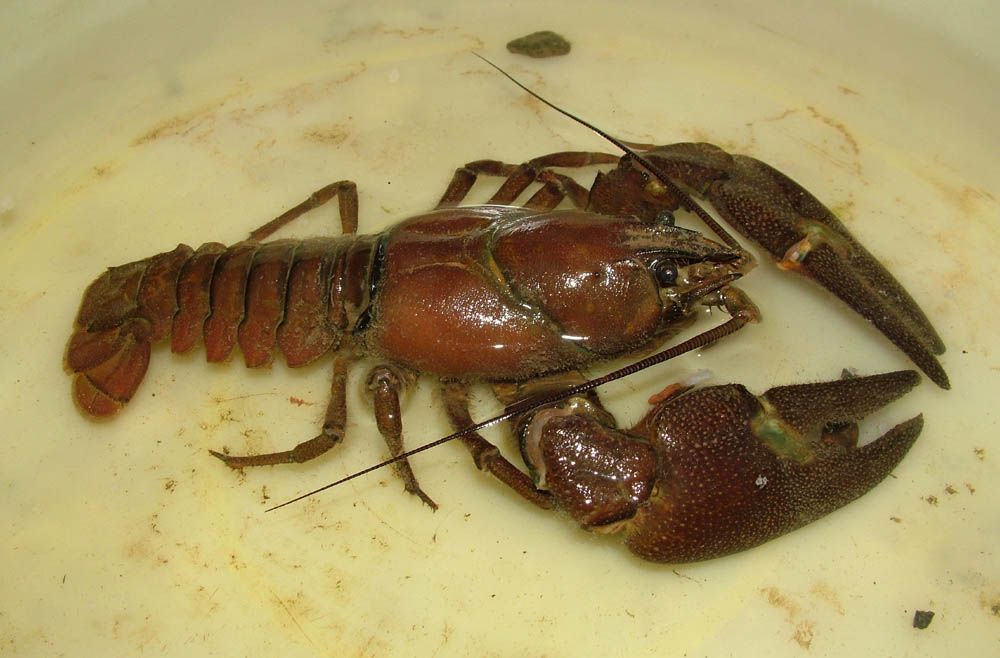
Cherax peknyi, Cherax Zebra, Cherax Tiger and Cherax Sp Papuana

A new species of crayfsh Cherax  (Cherax) peknyi  is described  from  the Fly River drainage, in the western province region of Papua New Guinea. This species differs from all others in its subgenus by the shape of the rostrum, and chelae, and in colouration. Cherax, new species, freshwater, crayfsh, Fly River, Papua New Guinea, Indonesia. Crayfish were collected at various locations in the Fly River catchment in 2005–2006, as part of a project aimed at developing techniques for aquaculture of indigenous species of Cherax. Techniques for sustainable aquaculture of Red-claw crayfish (Cherax quadricarinatus) were developed  in Queensland  in  the 1990s, and  it was hoped to adapt such techniques for similar species in Papua New Guinea.

Cherax peknyi are known to be present in the Fly River floodplain, and in the foothills of the mountains near the provincial capital of Kiunga. They are collected and eaten in all regions, particularly when the water level has receded during the dry season. The people knew of a crayfish with a soft red patch on  the claws of the males (as has Cherax quadricarinatus), but when we went collecting with them, they caught several species including the undescribed Cherax peknyi. Specimens were forwarded to Queensland Museum to ensure their presence was documented particularly important as some species are disappearing  from  the  Fly River  floodplain following the introduction of exotic predators such as the fish Anabas testudineus and Channa sp.


Specimens collected in Tamu Creek (a tributary of the Fly River in the Western Province of PNG) in 2006, were tentatively assigned as Cherax sp. “ papuana” by BH. We realised that these specimens perfectly matched  the species from the Merauke region introduced onto the German pet market as Cherax sp. “tiger” and Cherax sp.”zebra” in the year 2000, and which the senior author believed to be a new species. New Guinea has been the source for a highly lucrative trade in native fish from West Papua to Europe, in particular a number of rainbowfish species. The pretty colour patterns of this crayfish, and the ease with which it can be transported, makes it of particular interest to  the aquarium  trade. Crayfish collected from wild populations are supplied by wholesalers to the European, Japanese and USA pet markets. We here describe this distinctive crayfish as a new species, Cherax peknyi.


HABITAT AND LIFE HISTORY

The Cherax peknyi were usually found in slow fowing, still water, in parts of southern New Guinea with pronounced wet and dry seasonality. The villagers traditionally collect these animals when the water levels are low during the dry season, as in most places the water fow is too fast in the wet season. Clarity of the water depends on the level of fooding and time. The Tamu River (near the West Papua border) is muddy during the flood season, becoming clear after the initial foods, and then becoming stagnant, with dark (tannin stained) water full of rotting leaves, and almost anaerobic (DO<1mg/L) in the dry season. The crayfsh live under logs and in crevices and holes in submerged timber. They also live in burrows in the clay in the banks of the river. Even when the water is very low in dissolved oxygen they live in all water depths and in their holes. No berried females were collected in the dry season suggesting that breeding is in the wet season.

Generally the habitat is in monsoon gallery forest, however they persist where habitat modification has been severe (clearing and siltation), and breed and maintain populations in small creeks around Kiunga (e.g. near  the Kiunga school). These modified creeks have moderate flow throughout the year, and are highly turbid (secchi <50mm), and DO >4mg/l. Water temperature in small streams around Kiunga gets as low as 18°C, and up  to 29°C. A few of  the creeks  in which  they occur dry out completely, so they probably are able to survive in moist conditions for a couple of months, in burrows or moist logs.

We did not collect crayfish in the swamps, and the villagers only fish for crayfish in rivers in the forest behind the swamps. No crayfish have been collected in the main Fly River channel which is heavily populated by Macrobrachium rosenbergii. In  the streams Cherax peknyi was sympatric with Cerax albertisii and Cerax quadricarinatus, which are also collected for food by  the  local people during the dry season.

Cherax Tenuimanus Hairy Marron Beautiful Cherax

Cherax Tenuimanus or Marron were originally identified as a single species by Smith (1912). Two species of marron have now been formally recognised and described. The original species name ‘tenuimanus’, which once covered both species, is now restricted to the species that is endemic to the Margaret River, the Hairy Marron. The other, more common marron species, the Smooth Marron, now has the species name Cherax cainii. Cherax Tenuimanus are large freshwater crayfish which can grow to more than 380 mm in total length. They are one of the largest freshwater crayfish species in the world with specimens having been recorded in excess of 2 kg. The Cherax Tenuimanus or Hairy Marron has tufts of hair-like bristles on its carapace and other body surfaces. While adults are readily identified from the Smooth Marron (Cherax cainii), hybrids do occur and are more difficult to identify.

Cherax Tenuimanus are crepuscular or nocturnal, being most active for a few hours after sunset, especially around a new moon when water temperatures are above 18°C. Marron take at least two to three years to reach sexual maturity and are brooders with limited dispersal ability. Due to this breeding strategy, movement of both adults and juveniles is limited and is estimated to be in the order of several hundred metres with favourable conditions required (i.e. summer flood events) to assist the downstream movement of the species.


The Cherax Tenuimanus or Hairy Marron only occurs in the Margaret River in the south west of Western Australia. The species is currently listed as rare under the Western Australian Wildlife Conservation Act 1950 and is managed as 'critically endangered' (according to IUCN criteria) by the Western Australian Government. The upper reaches of the Margaret River, which contain the majority of the species’ known sites, are within managed State forest.

An interim Recovery Plan is currently being prepared for this species. In addition, the Western Australian Department of Fisheries manage the recreational marron fishery and have monitored marron populations for a number of years. Long term surveys (1970 – present) have been carried out by the Western Australian Department of Fisheries which show a decline in the abundance of marron in general and a decline in the range and abundance of the Hairy Marron in particular.


The decline in the Hairy Marron is considered to coincide with the introduction of the Smooth Marron to the Margaret River in the early to mid 1980’s. Monitoring of the species is based on surveys of recreational fishing licence holders and some field survey and therefore indicates a general trend of reduced abundance rather than absolute numbers. In late 2002, in order to reduce the impact of recreational fishing, the upper Margaret River, from 10 Mile Brook junction, was closed to marron fishing by the Western Australian Department of Fisheries.

In waterways of the south west, little is known of the ecology of marron  and habitat requirement differences between the Hairy and Smooth Marron species. Habitat requirements may be similar for both species. Information on the current distribution of the Hairy Marron indicates that the species requires relatively good quality water and a diversity of habitat structure (e.g. they generally prefer sandy areas, particularly where organic matter accumulates and access to shelter and refuge sites) and may struggle to persist in disturbed habitats.

Smooth Marron appear to have a competitive advantage over the endemic Cherax Tenuimanus or Hairy Marron and concern exists that if competition from, and hybridisation with, the Smooth Marron remains unchecked, it is likely that the Hairy Marron will be completely replaced in the wild by this species. Cherax Tenuimanus brood stock is currently held at the Pemberton Freshwater Research Centre with the aim of producing individuals for reintroduction into the Margaret River.

The Cherax Tenuimanus is naturally restricted. The species is currently known from only eleven sites along a section of the Margaret River and occurs in an area less than 50 km in length. The majority of the species’ population is restricted to pools located in the forests of the upper reaches, within an area of less than 10 km2. Very few Hairy Marron have been collected recently from the middle or lower reaches of the Margaret River, where the Smooth Marron is the predominant species recorded. The Cherax Tenuimanus persists within the upper reaches of the Margaret River surrounded by forested land and is now thought to be mainly restricted to the upper reaches of this system. This section of the Margaret River (i.e. the upstream State Forest areas) support the last significant wild populations of the Cherax Tenuimanus and the relative abundance of Hairy Marron compared to Smooth Marron is up to almost 50% within some pools of this section of the Margaret River.

Friday, December 9, 2011

Cherax Quadricarinatus Aquatic Species

Cherax quadricarinatus is a large freshwater crayfish species (Parastacidae) native of north-west
Queensland and the Northern Territory of Australia. The species typically exhibits a gonochoristic sexual system, although in cultured populations various types of intersex individuals have been described as functional males. In the present study, the macroscopic morphology and the gonadal histology of one type of intersex are described and discussed. All intersexes having both pairs of genital openings (female and male openings) and lacking both appendix masculinae and red patches were functional females with normal ovaries and oviducts. From a histological  point of view, they did not differ from normal females having previtellogenic and/or vitellogenic ovaries according to size.

Cherax Quadricarinatus
Cherax quadricarinatus is a large freshwater crayfish native of north-west Queensland and the Northern Territory of Australia which is intensively cultured  for economic purposes in Australia and many other countries in southern Asia, North and South America and  Africa. Although many biological aspects related  to the culture of C. Quadricarinatus have been studied,  including reproduction, growth and  nutrition, the sexual pattern of this species and its hormonal regulation is not fully understood.

Cherax Papuanus
Cherax Orange Papua
Cherax Albertisi
Cherax Quadricarinatus is considered a gonochoristic species with a bilaterally symmetrical reproductive system. In females, it consists of a pair of ovaries, oviducts and genital openings at the base of the third pereiopods,  while in males a pair of testes, vasa deferentia and genital openings at the base of the fifth pereiopods  are  observed. Cherax Quadricarinatus Males also present appendix masculinae at the base of the fifth pereiopods. An important male secondary sexual character is the soft red patch which is found on the outer surface of the propodus of the male claw giving to this species the common name of “red claw” crayfish. In this species, a variable proportion of several types of intersex animals can be found in which both male and female genital openings occur in different combinations. Morphological, biochemical and endocrinological studies of intersexes have  demonstrated that these individuals are functionally males with previtellogenic ovaries.
Cherax Sp. Blue Moon
According to some investigations done in our laboratory in which we observed some individuals having both pairsof genital openings being ovigerous “females” and hatching normal juveniles, we decided to carry out a macroscopic and histological analysis of the reproductive system of these intersex animals to achieve a better understanding of intersexuality in Cherax Quadricarinatus size, form and colour. Subsequently, they were quickly dissected and fixed in Bouin’s solution for 4h at  room temperature. Gonads were then sequentially passed through 90% ethanol for 20 min, 96% ethanol for 20 min, 96  %  ethanol-buthylic alcohol  (1:1  v/v)  for 30 min and buthylic alcohol for 30 min, and embedded in paraffin. Sections (5-6 μm thick) were stained with haematoxylin-eosin. At least three slides for each crayfish were inspected under light microscope.

Cherax Sp Papuanus, Cherax Papuanus, Cherax Sp Tiger, Cherax Tiger, Cherax Sp Asia Tiger
Cherax Asia Tiger, Cherax Sp Zebra, Cherax Zebra, Cherax Misolicus, Cherax Peknyi , Cherax Sp

Koura Freshwater Crayfish Conservation

New Zealand’s Freshwater Crayfish Ecology and Conservation

The koura, or freshwater crayfish, is endemic to New Zealand. It can be difficult to spot as it is often the same colour as the rocks at the bottom of its stream. It also stays hidden during the day, preferring to move around at night. Although genetic research is ongoing, there are two currently recognised species of koura found in New Zealand. The larger species (80 millimetres long) has very hairy pincers and is found in the east and south of the South Island and on Stewart Island. Koura in the North Island and in Marlborough, Nelson and the West Coast of the South Island are slightly smaller (about 70 millimetres long) and have less hairy pincers. 

The koura lives in freshwater streams, lakes, ponds, and swamps. Koura typically shelter between stones but they also can burrow into mud. Koura living in swamps will sometimes burrow deep into the mud when the swamps dry out over summer, waiting until the water returns to re-emerge. Some koura can live on the bottom of very deep, clear lakes in the South Island at depths of up to 60 metres.


The koura belongs to a group of animals called ‘crustaceans’, which all have a hard, shell-like covering. This covering eventually gets too small for the koura, and the animal must then shed the old layer in a process called moulting. The old shell-like skin splits and is left behind, while the new skin underneath hardens. During moulting, crayfish are very vulnerable to predators.

Koura, also known as kewai,use their four pairs of walking legs to get around quite quickly. They do not crawl as their common name ‘crawly’ suggests! When alarmed, the koura will switch into reverse gear, flicking its tail forwards violently to shoot backwards into shelter. The koura’s first pair of legs are pincers, which are used mainly for catching food and fighting orwarning off invaders. Instead of hunting for their food, koura are scavengers that feed on old leaves and small insects that float by in the water or settle onto the
lake or river bottom.

Female koura produce eggs between April and December (mostly in May and June). She carries
between 20 to 200 berry like eggs under the side flaps of her abdomen, when she is said to be ‘in
berry’. Small koura hatch about 3 to 4 months later looking exactly like their parents in miniature. They cling to their mothers with their pincers until they are nearly 4 millimetres long. By their fourth year they are 20 millimetres long and become adults.

Koura also act as an indicator species, signalling to scientists when conditions have become unhealthy for a range of organisms in that habitat. Scientists can therefore monitor koura populations in order to determine the overall health of a lake or river system. If freshwater crayfish are present in a stream, that is a good sign that the stream is clean.

New Zealand freshwater animals such as the koura are in danger because their habitats are disappearing. Less than 9% of New Zealand’s wetlands remain; most have been drained for farming. Many streams, rivers and lakes are now highly polluted, and the loss of riverbank vegetation can lead to erosion, making the water muddy and killing the food source for aquatic insects. Other threats include: 

- Illegal harvesting: koura may legally be gathered for personal consumption up to a limit of 50 crayfish per day. However, the selling, trading or possession of koura for the purposes of sale or trade is illegal.


- Introduced mammals: Although not a lot is known about the effects of land mammals on freshwater ecosystems, research has detected crayfish in theguts of trapped stoats, which suggests that land mammals may pose a threat to koura.

Crayfish Characteristics In Aquarium Australian Crayfih

Infected and dead crayfish are the main source of  A. astaci zoospores in the environment. Frequently, the introduction of resistant carriers with no or few visible lesions is responsible for transfer of the disease to susceptible crayfish that inhabit the same water body. On other occasions, when crayfish and zoospore densities are low, a long-term, low-grade pattern of mortality may occur because there are fewer crayfish to act as reservoirs of infection).

Mammals, such as otters, mink or muskrats, and waterbirds have sometimes been blamed for spreading crayfish plague in Europe, but scientific studies have found  that zoospores do not survive the temperatures of the gastrointestinal tract of mammals or birds. The movement of fish may be of greater concern in the spread of infection because zoospores remain viable in fish mucus and fish intestinal tracts. The cleaning and gutting of fish from other water bodies is another potential source of infection.

Red Claw Crayfish (Cherax quadricarinatus)
Under ideal conditions, even small amounts of water can transfer enough zoospores to infect a new water body. As few as 1.3 zoospores per millilitre of water can infect susceptible animals. The zoospores rapidly spread downstream in river current; movement upstream is slower and occurs by the movement of infected crayfish. Weirs, or large tracts of water that contain no crayfish, act as barriers to the spread of the disease via carrier crayfish. Most new outbreaks in countries where crayfish are harvested recreationally or commercially are caused by human activity, including translocation of contaminated water or crayfish from their site of origin and trapping using contaminated traps or  nets that have not been adequately disinfected.

Yabby (Cherax destructor)
 North American species of crayfish appear to have a host parasite balance that ensures continuity of both species without major population crashes. Overt disease resulting in crayfish mortality only occurs in North American species after stressful events, such as overcrowding or unseasonable weather. This sporadic pattern of disease outbreaks is typical of long-term coexistence of host and parasite.

Geographical location rather than phylogenetic origin is important in determining susceptibility to crayfish plague. For example, although Pacifastacus leniusculus is in the same family as European crayfish, it is resistant to the disease, whereas Cambaroides japonicus from Japan is susceptible despite being phylogenetically related to crayfish from eastern United States. Stress factors that predispose crayfish to crayfish plague include suboptimal water quality, high stocking density and intra- and interspecies aggression. The presence of abrasions on the exoskeleton also increases the likelihood of A. astaci gaining entry into the crayfish cuticle. This is more likely to occur immediately after moult, when the exoskeleton is still soft.  

Marron (Cherax tenuimanus)
Water temperature Astaci  is a parasite adapted to living in or near chitin. The substrains found on  Pacifasticus leniusculus in Europe are inherently cool/temperate water pathogens. Crayfish are readily infected with the disease between 2°C and 20°C whereas, at 25°C, not all animals become infected. At 13°C, zoospore production is greater than at 20°C, and zoospores are likely to be infective for longer. At temperatures below 10°C, infected crayfish take longer to die, and there are more gross signs such as limb autotomy (limb loss) and melanisation. At higher temperatures and high challenge, gross muscle necrosis is often the only disease sign. In a study using Australian red claw, A. astaci was more pathogenic at 14°C than at 20°C.


Characteristics of pathogen substrain There are at least four strains of Astaci, each having different growth, sporulation and zoospore characteristics and different temperature tolerances. The substrain found on Procambarus clarkii in Spain grows and sporulates better and has greater zoospore motility between 18°C and 25°C than other substrains. This appears to be an adaptation of P. clarkii to Spain’s climate, which is warmer than that of eastern United States. More strains with adaptations to different environmental factors will probably be identified in the future.

Crayfish Plague World Distribution and Diagnosis In Australia

Crayfish plague is a serious disease of freshwater crayfish in Europe. It is endemic in North America but rarely causes overt disease in North American species except when they are stressed. Early reports of crayfish deaths suggest that crayfish plague was present in Europe by 1875 and, although the source of infection was never proved, it was suspected to have been introduced with live, imported North American crayfish. There were further introductions of North American crayfish to Europe, most notably in the 1970s.

The earliest report in 1875 is from Italy, but the disease appears to have spread to the rest of Europe after 1975 from outbreaks in France and Germany. It has now been reported in Norway, Finland, Sweden, Russia, Germany, France, Switzerland, Spain, Greece, Turkey, the United Kingdom and Ireland. Losses of native European freshwater crayfish species have been catastrophic in infected waterways, and considerable resources have been allocated in several countries (including Finland and the United Kingdom) in an attempt to eradicate or control the disease.


 The advent of molecular techniques has confirmed earlier suspicions that A. astaci entered Europe from North America. Four major strains of  A. astaci have been found. Three have been identified on the signal crayfish, Pacifastacus leniusculus, which is one of the main North American species introduced to Europe. One strain appeared to have been introduced to Europe in the nineteenth century, a second was introduced to Sweden from the United States after 1970, and a third was found on Pacifastacus leniusculus from Canada. A fourth strain, found on Procambarus clarkii (red swamp crayfish) in Spain and the United States, is adapted to warmer water temperatures. The origin of outbreaks in Europe can now be traced using molecular tools.


Crayfish plague has never been reported in Australia or found during passive surveillance. To date, no outbreaks of crayfish plague have been reported in red claw in Europe, Ecuador or the United States despite the export of this species. Likewise, although  Pacifastacus leniusculus has been introduced to Japan, and Procambarus clarkii to Kenya, South America, China, Japan, Taiwan and the Philippines, there have been no reports of crayfish plague in those countries.


Crayfish plague must be suspected whenever there is a mortality event in which many crayfish die but other aquatic animals remain unaffected. Diagnosis is based on clinical signs, histopathology and laboratory culture of the disease agent. Methodology for diagnosis and isolation techniques is based on culture and characterisation of the fungus, and can be found in:

•  The OIE Manual of Diagnostic Tests for Aquatic Animals (OIE 2003);
•  The OIE International Aquatic Animal Health Code (OIE 2004);
•  Crayfish plague (Aphanomyces astaci) Australian and New Zealand Standard Diagnostic Procedure (ANZSDP)2; and
•  Molecular diagnostic tests to detect epizootic ulcerative syndrome (Aphanomyces invadans) and crayfish plague (Aphanomyces astaci).

Crayfish, Freshwater Crayfish and Crayfish Plague

Crayfish plague is a fungal disease that has the potential to cause large-scale mortality of freshwater crayfish in Australia. At present, the disease does not occur  in Australia. However, it is important that state and territory governments and the red-claw, yabby and marron aquaculture industries are adequately prepared to manage a disease outbreak, because an incursion of the disease could devastate the  freshwater crayfish aquaculture industry as well as wild populations of crayfish. The aetiological agent of crayfish plague is the oomycete,  Aphanomyces astaci Schikora. Oomycetes (commonly called water moulds) are not considered to be ‘true fungi’ taxonomically, but have been placed in the phylum Oomycota. Within this phylum is the family Saprolegniaceae, which consists of the  AchlyaAphanomyces and  Saprolegnia genera, with some species being pathogens of crustaceans, fish and plants.

Crayfish
Giant Crayfish
Astaci is a branching, non-septate fungus that produces spores under conditions that are favourable for the particular substrain. The spores can survive in fresh water for a variable time depending on water temperature and chemistry. Motile zoospores measuring 8–15 μm emerge from spores and attach to new hosts in the
water body.

Freshwater Crayfish
Giant Freshwater Crayfish
Freshwater crayfish species from Australia, New Guinea, Japan and Europe are highly susceptible to crayfish plague; species from North America are more resistant but can die from the disease if their immune systems are stressed, such as by overcrowding or extreme weather. The disease has not been reported in aquatic animals other than freshwater crayfish, but the Chinese mitten crab,  Eriochier chinensis,  was susceptible to infection with A. astaci in an experimental study.

Of the commercial crayfish species in Australia, the Red Claw Crayfish (Cherax quadricarinatus) and the yabby (Cherax destructor) have been tested and are susceptible to the disease, but there are no published reports of the susceptibility of marron (Cherax tenuimanus). Only a few Australian species of crayfish have been experimentally challenged with crayfish plague, but it is safe to assume that all Australian freshwater crayfish may be highly susceptible to infection. The susceptibility of many freshwater decapods to infection with  A. astaci is unknown. Consequently, the likelihood of animals such as freshwater crabs and  shrimp in Australia becoming carriers or developing clinical disease following infection with A. astaci in the wild is also unknown.

Twitter Delicious Facebook Digg Stumbleupon Favorites More

 
Design by PlanetAnimalZone | Bloggerized by PlanetAnimalZone - PlanetAnimalZone | Animal and Pets Review